
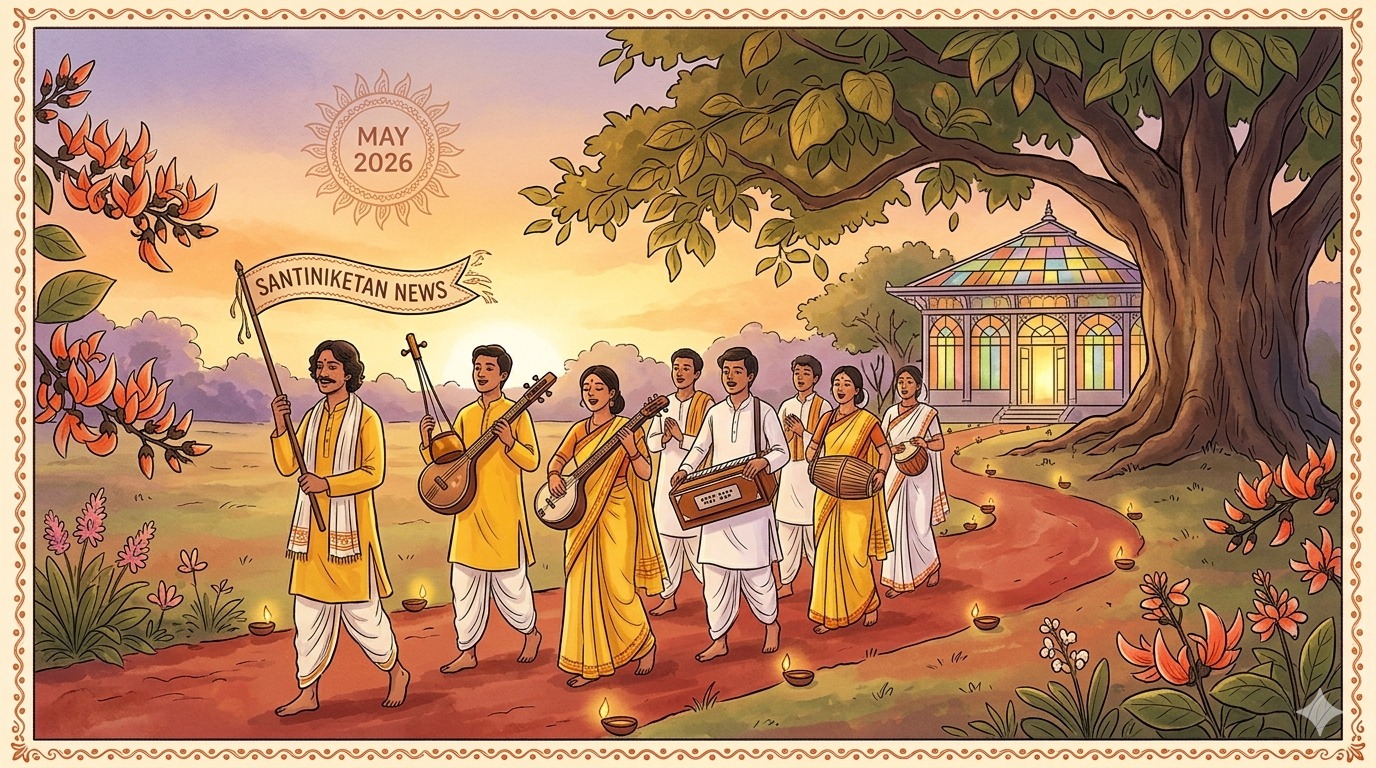
EDITORIAL: THE HEAT, THE RESULTS, AND THE FIRST SMELL OF RAIN
May does not arrive gently in Santiniketan. It arrives like a verdict — hot, clear, unambiguous. The sky over the Khoai in the mornings is a blue so deep and absolute it seems almost aggressive. By ten o’clock the paths are empty. By noon, even the crows have found shade.
And yet, May is not a month of stillness. Beneath the heat, the town hums with a quiet urgency that has nothing to do with festivals and everything to do with futures. Results are announced. Admissions are contemplated. Graduating students pack their rooms. Families make decisions. Artisans review their ledgers one final time before the off-season properly settles. And somewhere, in the last week of the month, the sky begins to change — a slight heaviness in the air, a different quality to the afternoon light — and the first conversation about the monsoon begins.
May is Santiniketan in the register of consequence. The year’s festivals are behind it. The rains are ahead. In between: the serious, unglamorous, necessary work of an institution and a community taking stock.
APRIL INTO MAY: DEEPENING QUIET
April had been the exhale after the festival season’s long held breath. May deepened that exhale into something closer to genuine rest — for the town, for the campus, for the artisans who had been producing steadily since October’s pre-Poush-Mela preparations.
- The tourism numbers that had already thinned in April thinned further in May. The homestays and guesthouses that had been at capacity for Basanta Utsav and Nabanna now settled into their quietest occupancy rates of the year — enough guests to keep the kitchens and conversations going, but few enough that a host and a guest could sit on a verandah after dinner and hear the night insects without competition.
- Weather enforced the new rhythm firmly. May temperatures in Bolpur regularly reach the high thirties, and the hours between eleven and four belong decisively to shade, ceiling fans, cold water, and patience. The town’s daily life — market, school-run, workshop, walk — compressed into the early morning and the long evening, with a midday pause that the heat makes non-negotiable.
- The pre-monsoon signals began appearing in the last week of the month: a slight increase in humidity, afternoon clouds building in the west, the occasional distant rumble that sent children to windows. Bolpur’s monsoon typically begins in earnest in June, but May’s final days carry its opening argument — and in the heat, that argument is persuasive.
1. RESULTS SEASON — THE VERDICTS ARRIVE
May is, above all else, the month of results at Visva-Bharati, and the university’s notice board — both physical and digital — became the most-watched surface in Santiniketan from mid-month onward.
- The School Certificate (Class 10) Examination results were published on 27 May 2026 — the culmination of a cycle that had begun with the exams in March and April. For Patha Bhavana’s Class 10 cohort, the wait had been long and the announcement carried with it the full weight of a first major public reckoning. Results were received with the full spectrum of responses that such announcements always produce: relief, celebration, quiet disappointment, and the immediate adult question of what comes next.
- The Pre-Degree Examination (10+2) results were confirmed on 25 May 2026, bringing to a close the senior school assessment cycle. The bhavanas that would receive these students as undergraduates in July began, quietly, to prepare.
- Even semester examinations for Visva-Bharati’s undergraduate and postgraduate programmes were scheduled through May, with Department of Economics and Politics and AIHCA publishing their even semester examination schedules on 12 May. The campus library and reading rooms were, through May’s middle weeks, among the most purposefully occupied spaces in Santiniketan.
2. POILA BAISAKH — THE BENGALI NEW YEAR IN SANTINIKETAN’S OWN VOICE
Before the examination results dominated May’s emotional landscape, the month opened in the shadow of one of Bengal’s most beloved calendar events: Poila Baisakh, the Bengali New Year, which fell in mid-April and carried its warmth well into May’s first week. In Santiniketan, the new year is celebrated differently from the rest of Bengal — quieter, more rooted, closer to the earth.
- While Kolkata marks Poila Baisakh with crowded street fairs and commercial noise, Santiniketan offered something slower: Baul music at dawn in the Sonajhuri forest, tribal dance performances by local communities, and the particular Tagore-inflected understanding of a new year as renewal of creative rather than commercial life. Visitors who chose to spend the new year here found the contrast with the city version startling and restorative.
- The Sonajhuri Atithi Nibas and several homestays in the area hosted Poila Baisakh programmes — early morning music, communal meals of traditional Bengali food, and evening storytelling sessions — that gave the new year a genuinely participatory character for guests willing to wake early enough.
- For residents, Poila Baisakh in Santiniketan carries the additional weight of beginning the year in a place where Tagore himself thought deeply about what a year’s beginning should mean: not the frenzy of acquisition and resolution, but the quiet resolve of a creative being turning toward new work.
3. ARTHSHILA IN MAY — FROM EXHIBITION CLOSE TO NEW BEGINNINGS
Arthshila Santiniketan remained one of the most consistently alive cultural venues through the heat of May, its programming continuing with the seriousness of purpose that distinguishes it from the festival-season calendar.
- The landmark exhibition “Mother of 1084” — a documentary performance-installation curated by Zubaan and designed by Studio Ferment — ran at Arthshila from 6 March through 17 May 2026, closing in a final weekend of performances on 15–17 May. The exhibition, which engaged with Mahasweta Devi’s political novel through documentary and visual art, drew a specific, engaged audience: scholars, activists, theatre practitioners, and the kind of reader who treats a gallery visit as a form of research.
- The closing weekend of the exhibition — 15–17 May — brought a small but significant gathering to Arthshila at a time of year when most cultural calendars in the region had gone quiet. The conversations it generated, between practitioners of different disciplines, were the kind that Arthshila’s founders had presumably imagined when they built a cultural space in Santiniketan’s orbit: serious, cross-disciplinary, unhurried.
- With the exhibition closed, Arthshila turned its attention to its next programming cycle — film screenings, workshop series, and the continuing evening events that keep its verandah occupied even through the hottest months. For a visitor to Santiniketan in May, an Arthshila evening is among the most reliable and rewarding options on offer.
4. CHANDRAKALA DANCE FESTIVAL — A SMALL STAGE, A SERIOUS OCCASION
One of the month’s most quietly significant cultural events arrived courtesy of the 4th Chandrakala Dance Festival 2026, which culminated in a presentation festival on 8 May.
- The festival, connected to a workshop series that had been running in the lead-up to the performance day, brought together classical and contemporary dance practitioners in the Santiniketan tradition of learning-by-doing: the workshop and the stage as continuous rather than separate experiences.
- The 8 May presentation was a reminder that Santiniketan’s dance culture does not hibernate with the departure of Basanta Utsav’s grand performances. The smaller, workshop-born presentation — less theatrical, more rooted in process — is in many ways the truer expression of what the town’s educational philosophy is about: form emerging from rigorous practice rather than spectacle mounted for an audience.
- Events like Chandrakala are the connective tissue of Santiniketan’s cultural life — not famous enough to appear in travel guides, but important enough that their disappearance would be felt immediately by anyone who pays close attention to the town’s creative health. May, with its smaller audiences and more attentive visitors, is exactly the right month for them.
5. GRADUATING STUDENTS — THE BITTERSWEET DEPARTURE
No account of Santiniketan in May is complete without reckoning with the emotional texture of a campus losing — and celebrating — its graduating cohort. The final weeks of the semester at Visva-Bharati carry a specific atmosphere that those who have experienced it do not easily forget.
- The bhavanas — Sangeet Bhavana, Kala Bhavana, Palli Bhavana, Silpa Sadana — each develop their own farewell culture over the years: informal concerts, shared meals in studios, long nights of music that stop only when the light changes. These are not official events; they are the organic expression of communities that formed over years of shared study and shared place, and now face the abrupt fact of separation.
- For many graduating students, Santiniketan is not merely where they studied but where they became the people they will be for the rest of their lives. The ashram’s trees, the Khoai walks, the particular quality of late-afternoon light on the campus paths — these lodge in the memory with an intimacy that conventional university campuses rarely produce. The departure is, consequently, never entirely clean.
- Faculty who have seen many such departures describe May as the month when the campus most fully understands itself: it is not primarily a place of examinations and results but of formation — of people shaped by proximity to Tagore’s ideas, to each other, and to the particular beauty of Birbhum’s red-earth landscape. The results and certificates are the official record. What the students carry with them is something else entirely.
6. ARTISANS — THE LEDGER AND THE LOOM
By May, the artisan community’s post-season review was complete, and the work of the off-season months had begun to find its own rhythm — quieter, more experimental, less constrained by the immediate demands of festival commerce.
- Kantha collectives had completed their season analysis and arrived at conclusions broadly in line with the direction of travel established in recent years: the digital channel was growing slowly but consistently, with May bringing a further trickle of orders from visitors who had purchased at Nabanna in March and were now buying again — gifting, restocking, or simply unable to stop thinking about a particular piece. The trickle is not yet a stream. The stream is not yet a river. But the direction holds.
- Several Dokra workshops used May’s relative quiet to undertake the kind of ambitious, time-consuming experimental pieces that the festival production schedule never allows: larger forms, new alloy combinations, designs that reach beyond the established repertoire of tourist-facing objects toward something more strictly sculptural. Whether these pieces will find buyers is a secondary question. The primary question — what else can this tradition do? — is, in itself, a sign of creative health.
- The apprenticeship work that had been running since April continued through May, with master artisans passing on techniques that exist in no manual and cannot be learned from any screen. The heat of the workshop in May is considerable; so is the quality of the attention on both sides of the transmission. That this work happens in the off-season, without audience or documentation, is both its limitation and its integrity.
7. COMMUNITY IN THE DEEP HEAT
May is when Santiniketan’s permanent community — the residents who are neither students nor visitors, but simply people who live and work here — is most visible and most itself. With the festival season over and the tourism crowds dispersed, the town belongs, briefly and completely, to those who belong to it.
- The monsoon preparedness conversations that begin in May have a particular character in Santiniketan: part anticipation, part practical planning. Paths that flood, roofs that need attention, drainage channels that have silted since last year — these are the concerns of a town built for human-scale living in a landscape that receives significant rainfall. The rain is coming. The question is whether the infrastructure is ready for it.
- The solar investments made by several businesses and homeowners earlier in the season were, by May, proving their worth — providing power stability through the months when demand is highest and grid reliability sometimes least dependable. In a town that aspires to live lightly on the earth, these investments carry a symbolic weight beyond their practical utility.
- Conversations about managing the 2026–27 festival season — what to replicate, what to change, how to protect the ashram’s integrity while welcoming visitors — continued in local bodies and community forums. The lessons of March’s crowd pressures had not been forgotten; if anything, the quiet of May made them easier to think about clearly. The next Poush Mela is seven months away. The planning time is now.
LOOKING AHEAD: MONSOON AND THE RETURN OF THE YEAR
As May ends, Santiniketan turns toward what residents and longtime visitors consider its most privately beautiful season: the monsoon.
- June will bring the rains — first tentative, then decisive. The red laterite paths that have been cracked and pale through the summer months will darken and gleam. The sal and palash forest will deepen into a green so rich it seems almost implausible. The Khoai, which has sat dry and sculpted through the heat, will fill with reflected cloud. Santiniketan in the rains is a different country, and those who discover it rarely stop returning.
- The academic year will reset in July, with the odd-semester beginning to bring fresh students to the bhavanas — new faces navigating the campus for the first time, finding their way between the studios and the library and the particular tree under which they will eventually decide to spend most of their reading hours. The cycle that ends with May’s farewells begins again with July’s arrivals.
- And through June and July, the Poush Mela planning will begin — quietly, without announcement, in the minds and notebooks of organisers who know that December arrives faster than it seems possible. The year, in Santiniketan, is a wheel: and May is the hinge point at which last season finally releases its hold and the next one, still months away, begins its first tentative revolution.
May asks nothing of you but patience. Give it that, and it gives back something the other months cannot: the town at the deepest pitch of its ordinary, unhurried self.