
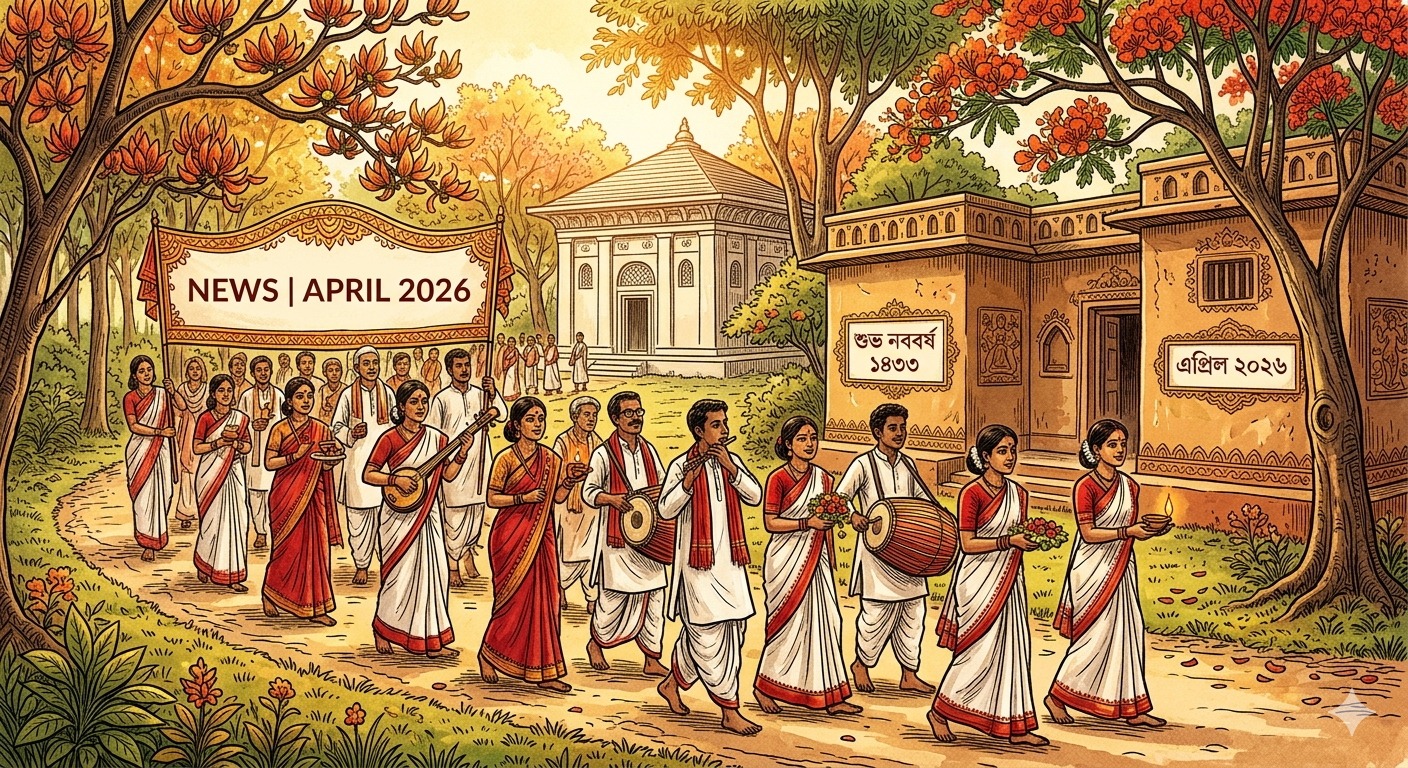
EDITORIAL: WHEN THE RED EARTH HEATS UP
The palash petals are gone. The abir has washed away from the paths. The trains from Howrah are no longer full on Friday evenings. April has arrived in Santiniketan and, as it always does, it has arrived quietly — the way a house settles into itself after a long party, finding its true dimensions again in the silence.
There is a version of Santiniketan that only April reveals. It is not the version captured in photographs of colour-drenched mornings or lamp-lit mela evenings. It is slower, warmer, more internal. Students sit under trees with notebooks rather than instruments. Artisan workshops smell of fresh clay and patience rather than festival urgency. The paths of the ashram, freed from the respectful shuffling of a thousand visitors, remember what it is to be walked by people who live here.
This is not a lesser Santiniketan. It is simply a different one — and, for those who know how to read it, perhaps the most honest one of all.
MARCH INTO APRIL: THE EXHALE
March handed April a town in a state of productive decompression. The last Nabanna fair stalls had been dismantled. The Geetanjali Cultural Complex had returned to its everyday function. The campus paths were clean again, the abir fully scrubbed from the flagstone outside the Upasana Griha. What remained was not emptiness but a kind of purposeful quiet — the quiet of an institution that knows exactly what comes next.
- The rhythm shifted almost overnight from festival-facing to inward-facing. Where February and March had oriented the town toward visitors and performances, April oriented it toward students, syllabi, and the serious work of an academic semester approaching its end.
- Tourism did not stop — it never entirely does — but it changed character. The selfie-seekers and day-trippers who had descended for Basanta Utsav gave way to a smaller, more deliberate kind of visitor: the kind who arrives with a book and a notebook rather than a camera tripod.
- Weather enforced its own discipline. April mornings in Birbhum are still manageable — cool enough before eight, golden and pleasant by nine — but by noon the sun is serious, and the wisdom of following the local rhythm (early rising, midday rest, evening activity) becomes self-evident to even the most energetic visitor.
1. EXAM MONTH AT VISVA-BHARATI
April at Visva-Bharati is, above all else, an exam month — and the campus shows it. The informal clusters of students under trees playing ektara or sketching in the late afternoon, which are such a defining image of the ashram in festival season, give way in April to more focused configurations: the quiet of a study group, the purposeful walk between library and hall, the small anxieties of semester-end.
- The Pre-Degree (10+2) examinations concluded on 7 April 2026, drawing to a close a formal examination cycle that had run since late February. For the senior school students of Patha Bhavana and its affiliated institutions, the completion of these exams marked the beginning of a liminal period — between school life and the university years that many of them will spend in the very same town.
- The School Certificate (Class 10) examinations continued through 17 April 2026, giving the month an exam-room atmosphere well into its third week. Patha Bhavana’s younger cohort navigated these weeks with the mix of anxiety and resilience that is particular to fifteen-year-olds sitting their first major public assessments.
- Good Friday, 3 April, offered a brief pause — a single day of institutional quiet in the middle of the exam season that many students, faculty, and residents used for rest, informal music, or simply a slower morning. In a month defined by academic pressure, small pauses carry unusual value.
2. OFF-SEASON TRAVELLERS AND QUIET PATHS
April is Santiniketan’s open secret. Those who know the town well — who have been coming for years, through every season — will tell you privately that April is among the best months to visit. You will not find this opinion on most travel websites, and that is precisely the point.
- The visitors who come in April arrive by choice rather than by calendar. They are repeat guests at familiar homestays, Tagore researchers from universities across India and abroad, writers and artists seeking an extended period of working quiet, and the occasional foreign traveller following a more personal itinerary than the festival-season guides suggest. They tend to stay longer, spend more thoughtfully, and leave with a more complex understanding of the place.
- Their days have a particular shape: early morning walks through the ashram before the heat builds — the deer occasionally visible in the early light, the Khoai glowing amber before eight — followed by midday withdrawals into shaded rooms, verandahs, and the air-conditioned quiet of the university library. Evenings belong to Sonajhuri, to long dinners in homestay courtyards, to conversations with hosts who finally have the time to sit and talk.
- Artisans, in particular, appreciate the April visitor. The unhurried guest who arrives at a Kantha workshop not to buy quickly but to understand slowly — who asks about the thread count, the motif’s origin, the weaver’s training — receives in return a quality of attention and explanation that the festival-season crowds, for all their enthusiasm, rarely allow. April is when craft knowledge is genuinely exchanged.
3. APRIL FESTS: POLYTECHNIC, NURSING AND ARTHSHILA
If March was one great concentrated burst of cultural energy, April is a scattering of smaller lights — institutional fests, workshop series, and niche gatherings that reveal the breadth of Santiniketan’s educational and cultural ecosystem beyond Visva-Bharati’s famous campus.
- Santiniketan Institute of Polytechnic opened its Annual Fest 2026 across 3–5 April, three days of student-driven performances, technical competitions, cultural contests, and the particular electric energy of an engineering college briefly becoming something more than a place of vocational learning. The fest drew students from across Birbhum and beyond, injecting a youthful, unironic enthusiasm into a town that had barely caught its breath from March.
- Santiniketan Sebaniketan Nursing Institute held its own annual celebrations in the same early-April window, a reminder that the Santiniketan name now anchors a cluster of institutions — medical, technical, educational — that together constitute a significant local knowledge economy alongside the more celebrated university.
- Arthshila Santiniketan offered its “Drawing the Line — A Poster-Making Workshop” from 10–12 April 2026: three days of hands-on visual communication practice led by working designers, combining the town’s art-education heritage with a contemporary professional idiom. It was the kind of focused, craft-serious workshop that Arthshila does best — and that fits the April mood perfectly, too purposeful for festival season, too creative for exam halls.
- Toward month’s end, Santiniketan Medical College hosted a social media and influencer meet on 26 April — a small but telling sign of how the town’s institutions are engaging with new modes of communication and visibility. That a medical college in Santiniketan is thinking about digital presence and creator communities is, in its quiet way, as significant as anything that happens on the more celebrated stages.
4. EVENING CULTURE: WORKSHOPS, BAULS AND BAITHAKIS
Heat reorganises a town’s cultural life. In April, the performing arts do not disappear — they migrate. They move from the open-air amphitheaters and forest clearings of the festival season to covered verandahs, small auditoriums, and the private rooms of homes where music has always been made without announcement or ticket.
- Arthshila continued its evening programming through April: film screenings, design talks, and architecture discussions in its distinctive indoor spaces — events that drew small, informed audiences who preferred depth to spectacle. The conversations that follow an Arthshila film screening on a warm April evening, spilling out into the courtyard as the night cools, are a specific Santiniketan pleasure not found in any travel itinerary.
- Baul music did not retreat entirely with the season. Practitioners who live in and around the Birbhum villages continued their occasional informal performances — sometimes at Sonajhuri, more often in private homes or small performance spaces — for the smaller, more attentive audiences that April provides. There is an argument that Baul music heard in April, in a room of twenty people rather than a forest of two thousand, lands differently: the words more audible, the silence between phrases more present.
- The baithaki tradition — the intimate, semi-private music gathering rooted in the old Bengali house-concert format — reasserted itself across the month. Several homestays hosted informal evening sessions: guests and hosts together, someone with a tanpura, someone with a tabla, the playlist built from the mood of the room. These evenings are unannounced, unrecorded, and unmarketed. They are also, by most accounts, unforgettable.
5. ARTISANS AFTER THE FESTIVAL RUSH
The festival season — from Poush Mela in December through Nabanna’s closing weekend in early March — is the spine of an artisan’s commercial year. April is the vertebra count: the careful, sometimes sobering assessment of what the season added up to, followed by the quiet recalibration that will shape the next year’s work.
- Kantha collectives across Bolpur and its surrounding villages spent April reviewing their season sales with a level of detail that the busy months rarely allow. The pattern that emerged was broadly encouraging: direct-buyer engagement at Nabanna had outperformed intermediary-heavy channels, and the handful of collectives that had listed products on digital craft platforms were seeing a slow but steady trickle of follow-up orders from March visitors who had gone home and wanted more. The trickle is not yet a stream, but the direction is clear.
- Dokra and terracotta artisans took a different lesson from the season: the growing awareness among buyers of the UNESCO heritage context was shifting the conversation in their favour — making it marginally easier to hold prices at levels that reflect actual skill and time, rather than collapsing under the pressure of bargaining from buyers accustomed to souvenir-shop economics. Each such conversation, small as it is, is a structural change in the making.
- For many craft groups, April is also the month of deep making — not production for sale but production for knowledge. Senior artisans work with younger apprentices on techniques that cannot be rushed: the precise geometry of a Dokra spiral, the tension required for a particular Kantha stitch, the chemistry of natural dyes mixed at the right temperature. In the heat of April afternoons, behind closed workshop doors, the real transmission of heritage happens.
6. COMMUNITY IN THE HEAT
There is a domestic intimacy to Santiniketan in April that the festival months obscure. With fewer visitors in the lanes and more residents simply living their lives, the town’s community texture becomes visible: the rhythms of the market, the school-run, the tea stalls, the evening chat at the corner.
- The practicalities of April heat shape the town’s daily schedule with quiet authority. Most shops on Bolpur’s main streets follow a modified pattern: open early, break during the hottest midday hours, reopen in the afternoon into the early evening. Visitors who arrive without understanding this rhythm and try to buy, visit, or eat at noon encounter closed shutters and the good-natured suggestion to come back at four.
- Power demand rises noticeably in April, and the infrastructure — fans, coolers, the occasional air conditioner in a homestay or guesthouse — is pressed harder than in any other month. Several local businesses and homeowners used the post-season cash flow from February and March to invest in solar panels or more energy-efficient cooling: a small green dividend from the tourism economy that is easy to miss but worth noting.
- Community conversations about the management of future peak seasons — which had begun in the immediate aftermath of March’s crowds — continued through April with more focus and specificity. Discussions about visitor caps, coordinated parking, waste management around Sonajhuri, and signage in the Khoai area moved, in some cases, from informal conversation to the agenda of local bodies and institutional committees. The urgency was real: Santiniketan cannot be loved to pieces.
LOOKING AHEAD: INTO MAY AND THE LONG SUMMER
As April closes, the heat deepens and the town’s pace slows further. May is not a month that Santiniketan performs for anyone — it is a month in which it simply exists, and that existence has its own undemonstrative beauty.
- Exam results for the school-level cycles will arrive in May, with the attendant anxieties and reliefs of students and families across the Birbhum district. For Visva-Bharati’s bhavanas, the semester will move toward its formal close, with internal assessments, final submissions, and the particular bittersweet energy of a graduating cohort preparing to leave.
- Admissions conversations will begin — tentative at first, then more urgent — as families consider Patha Bhavana, Siksha Satra, and the various degree programmes at Visva-Bharati for the coming academic year. For many Bengali families, a child at Santiniketan remains a particular kind of aspiration: an education in something that cannot be precisely named but is immediately recognisable.
- And somewhere in the deep May heat, the first conversations about the monsoon will begin. Not planning, not yet — just the human instinct, in the hottest week of the year, to close one’s eyes and imagine the smell of first rain on red laterite. In Santiniketan, that smell is worth the entire summer wait.
April has no spectacle to offer. What it offers instead is rarer: the town itself, unhurried, unperforming, entirely at home.