
EDITORIAL: THE CLASSROOMS FILL, THE GODDESS IS INVOKED
There is a specific sound that returns to Santiniketan every September: the scrape of chairs in a lecture hall that has stood empty through the admission season, the overlapping chatter of students who do not yet know each other’s names, the particular nervous energy of a first class. After months of merit lists, hostel allocations, and administrative waiting, September is the month when all of that paperwork finally becomes a lived, breathing thing — a campus with people in it again.
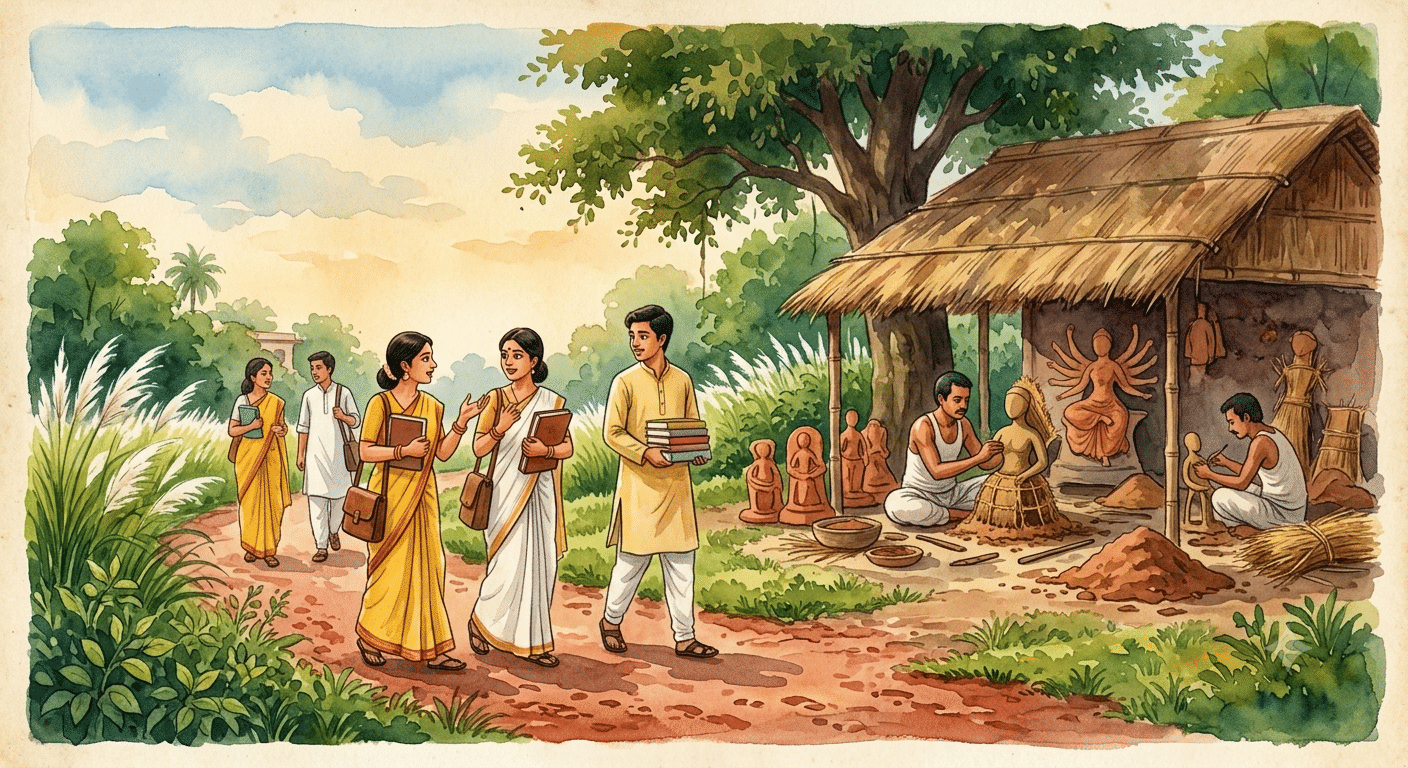
And then, almost without transition, the town’s attention shifts outward to something older than any university. By the last weeks of September, the clay idols that will become Durga over the following weeks were already taking shape in workshops around Bolpur, hands and faces emerging from straw-and-mud frames, a yearly act of transformation that has nothing to do with academic calendars and everything to do with a different, deeper calendar that this whole region keeps.
September, in other words, asks Santiniketan to hold its two defining identities at once: a university town beginning its year, and a Bengali town beginning its most important season of devotion.
AUGUST INTO SEPTEMBER: FROM MERIT LISTS TO MORNING LECTURES
August had closed with provisional merit lists settling into confirmed admissions, hostel rooms being assigned, and a campus visibly preparing to receive its new undergraduate cohort. September delivered on that preparation with unusual promptness.
- The university’s administration moved quickly once admissions were finalised, and the gap between “admitted” and “attending first lecture” closed faster this year than in many recent ones — a small but telling sign of improved coordination between the admission cells and the teaching departments.
- The monsoon, which had dominated June, July, and much of August, began its long, uneven retreat through September, leaving behind the deep, saturated green that defines Birbhum’s early autumn landscape — a visual backdrop against which the campus’s new arrivals took their first walks between hostel and classroom.
- The town’s rhythm shifted again, this time toward the specific texture of a university fully in session: more cycles on the roads between hostels and bhavanas, more informal gatherings outside lecture halls, the low hum of an academic year that had, after a summer of anticipation, actually begun.
1. SEMESTER-I CLASSES BEGIN — THE NEW COHORT ARRIVES
The defining institutional event of September was straightforward and long awaited: the actual commencement of teaching for the newly admitted undergraduate batch.
- All Semester-I classes for the Four-Year Undergraduate programme and the Five-Year Integrated Science programme under Siksha-Bhavana for the 2026–27 session formally began on Monday, 7 September 2026 — the date around which the entire month’s institutional energy organised itself.
- For the newly admitted students, the first week of classes carried the particular disorientation and excitement that every fresher batch experiences: finding the right lecture hall, learning which professor expects what, discovering which tea stall near which bhavana serves the best snacks between classes.
- Faculty across departments used September’s opening weeks for the foundational work of any new semester — syllabus introductions, baseline assessments, and the slow process of a class finding its own collective rhythm, a process that in Santiniketan’s open, tree-shaded campus setting often happens as much outside the classroom as within it.
2. JANMASHTAMI — A DEVOTIONAL OPENING TO THE MONTH
The month opened, fittingly, with a major Hindu festival: Krishna Janmashtami, observed on Friday, 4 September 2026, just days before the academic year’s formal start.
- Observed as a gazetted public holiday across much of India, Janmashtami in Bengal carried its usual mixture of midnight ritual, fasting, and devotional singing, with households and temples in and around Bolpur marking the occasion according to the Nishita Puja timings particular to the region.
- The festival’s timing, arriving just before the academic calendar’s own fresh start, gave early September a brief, reflective pause before the busier administrative and teaching rhythm of the rest of the month took hold — a small devotional breath before the semester’s first real exhale.
- For many of the new students arriving in Santiniketan for the first time that same week, Janmashtami offered an early, unplanned introduction to the way festival and academic life sit close together in this town — never entirely separate, always quietly informing each other.
3. PHD ADMISSIONS — THE RESEARCH PIPELINE MOVES FORWARD
While undergraduate admissions dominated the visible, campus-wide story of September, a quieter but equally significant process unfolded in parallel: the university’s PhD admission cycle for the 2026–27 session.
- The formal online application process for PhD programmes across departments opened in the first half of the month, with the notification published on 11 September setting out the schedule that doctoral aspirants across the country would need to follow.
- By the month’s final week, individual departments were issuing their own interview notifications for shortlisted candidates — Environmental Science and Botany scheduling interviews for 30 September, Chemistry following closely behind — a sign of how efficiently the research-admission machinery moved once the application window closed.
- This PhD cycle, running almost entirely out of public view compared to the undergraduate admissions drama of July and August, nonetheless represents an equally important part of what keeps an institution like this one intellectually alive: the steady, generational renewal of its research community.
4. THE GODDESS TAKES SHAPE — DURGA PUJA PREPARATIONS BEGIN
Even as the academic calendar absorbed most of September’s institutional attention, a different and older calendar was quietly asserting itself across Bolpur: the preparation for Durga Puja, Bengal’s grandest annual festival.
- By the third week of September, artisans in workshops around Bolpur were already deep into idol-making, shaping clay and straw into the recognisable form of the Goddess and her family in the traditional “Ek Chala” single-base style that remains especially cherished in this part of Birbhum, even as more elaborate multi-structure idols have become common elsewhere in the state.
- The work of idol-making — the layering of clay, the shaping of faces, the final touches of paint and ornamentation — follows a strict and ancient timeline of its own, one that has nothing to do with university semesters and everything to do with the approaching date of Mahalaya, the ritual beginning of Devi Paksha, falling this year in the second week of October.
- For the artisan families who undertake this work, September is a month of intense, focused labour — the culmination of planning that in some cases stretches back to the quieter monsoon months, when materials were gathered and designs were finalised in anticipation of exactly this moment.
5. CAMPUS LIFE SETTLES INTO ITS SEMESTER RHYTHM
Beyond the headline events of new classes and PhD admissions, September’s quieter story was the gradual, almost imperceptible way a university campus settles into its working rhythm after months of administrative flux.
- Hostels that had filled through August’s allocation process found their own social equilibrium in September, with new residents establishing routines, friendships, and the informal hierarchies and traditions that every hostel community eventually develops.
- Bhavana life resumed its full texture: music drifting from Sangit Bhavana’s practice rooms in the evenings, studio lights still on in Kala Bhavana well after dusk, the particular busy quiet of Vidya Bhavana’s seminar rooms during the day.
- Senior students, many of whom had spent the summer months away, returned to a campus simultaneously familiar and subtly changed by its newest arrivals — a reminder that a university town renews itself every single year, never quite the same place twice even as its essential character persists.
6. ARTISANS AND COMMUNITY — AUTUMN’S FIRST STIRRINGS
As the monsoon thinned and the festival season’s early preparations intensified, Birbhum’s broader artisan and trading community felt the particular economic quickening that always precedes Durga Puja.
- Terracotta and pottery workshops, having managed a slower, weather-constrained pace through the heaviest monsoon months, found conditions easing in September, allowing firing schedules to normalise just as demand for festival-season decorative and devotional items began to build.
- Kantha embroidery and textile groups continued the planning work begun in August, moving from assessment toward active production as the broader festive buying season — beginning with Durga Puja in October and continuing through the winter months toward Poush Mela in December — drew closer.
- Local markets in Bolpur began their own quiet seasonal shift, with shopkeepers starting to stock festival-specific goods and anticipate the increased footfall that October’s celebrations reliably bring to the region’s commercial life.
LOOKING AHEAD: MAHALAYA AND THE ROAD TO DURGA PUJA
As September closes, Santiniketan and the wider Birbhum region look toward October with the particular anticipation that only Bengal’s greatest festival can generate.
- Mahalaya, falling on Saturday, 10 October 2026, will mark the formal beginning of Devi Paksha and the traditional invocation of the Goddess’s descent — the moment when, for Bengali households everywhere, the festival season is understood to have truly begun.
- The main five days of Durga Puja will run from Maha Shashthi on 16 October through Vijaya Dashami on 21 October, with Maha Ashtami’s deeply significant rituals falling on 19 October — a sequence that will transform Bolpur and the surrounding villages into their most vividly festive state of the entire year.
- Visva-Bharati’s own academic calendar will pause for the occasion, with Puja holidays for all running from 17 October to 26 October — meaning the new semester’s early momentum will meet, within weeks, the region’s oldest and grandest interruption of ordinary life.
September asked Santiniketan to begin two things at once — a new academic year, and the long, patient work of inviting the Goddess home. Both, in their own ways, are acts of renewal.