
EDITORIAL: THE CAMPUS FILLS, THE NATION TURNS EIGHTY
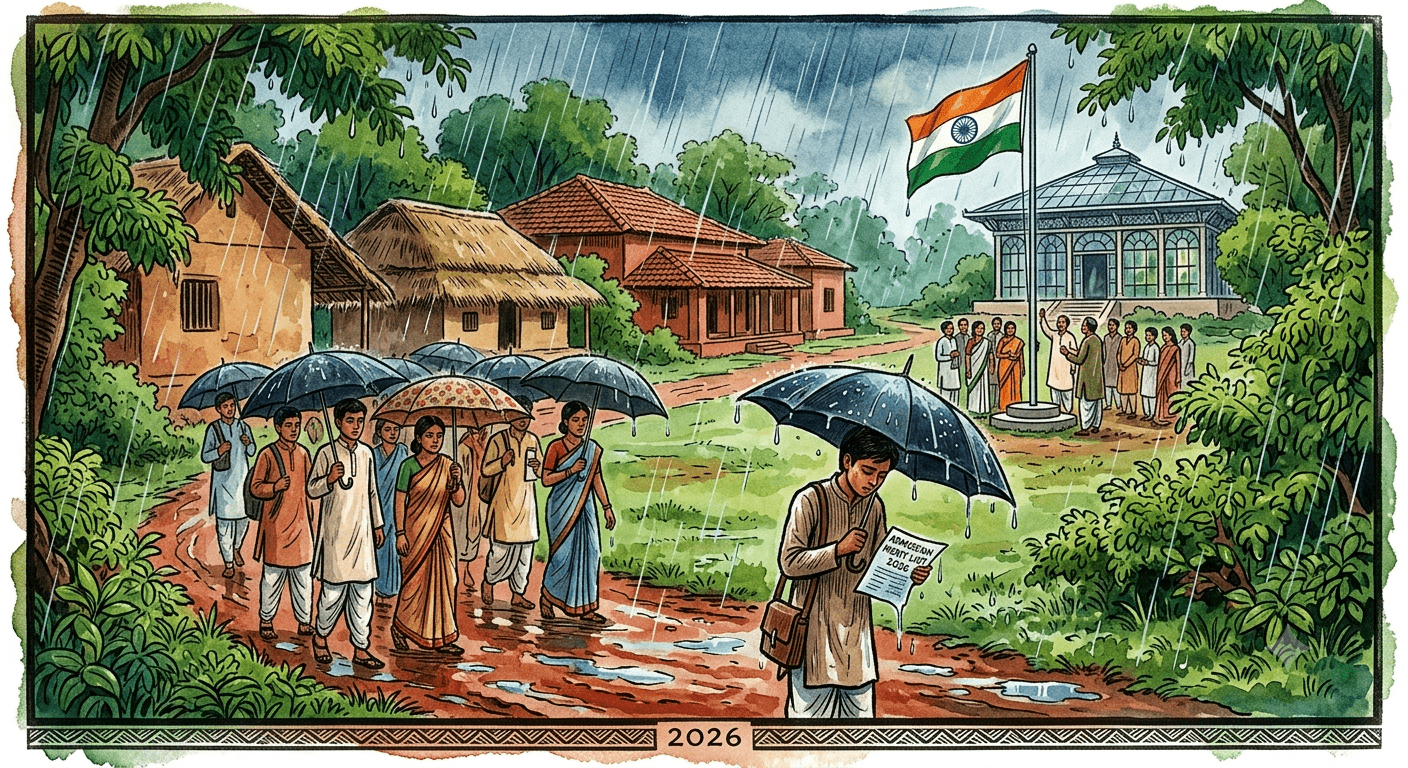
August in Santiniketan carries two kinds of arrival at once. The first is intimate and local: the long-awaited merit lists finally appear on a screen, a name is found in a list of names, and somewhere in Kolkata or Ranchi or further afield, a family begins packing a trunk for Bolpur. The second is national and vast: this August, India marked its 80th year of independence, and even a town as inward-facing as Santiniketan found itself, for a week, looking outward toward the flag, the anniversary, and the accumulated weight of eight decades.
The rains have not yet finished their work. They fall still, generously, on a campus that is simultaneously winding down its administrative summer and gearing up for the actual, physical arrival of a new academic year. There is a particular kind of energy in Santiniketan in late August — equal parts monsoon-soaked stillness and imminent bustle — as if the town is holding its breath just before the exhale of a new September.
This bulletin is about that held breath: the merit lists, the flag, the swings of Jhulan Yatra, and the quiet, monsoon-drenched work of a university and a town preparing to begin again.
JULY INTO AUGUST: FROM APPLICATION TO ADMISSION
July had closed on the anxious, paperwork-heavy note of CUET counselling deadlines and correction windows. August delivered the results of that anxiety, translating registration numbers into actual names on actual lists — the moment every admission cycle exists to produce.
- The wait that had defined much of July resolved, for thousands of families, into the specific and consequential act of checking a merit list — refreshing a webpage, calling a helpline, comparing a roll number against a PDF, and experiencing, in that instant, either relief or the beginning of a difficult conversation about alternative plans.
- The monsoon itself showed no particular deference to the academic calendar, continuing its heavy, familiar pattern through August’s first weeks even as the administrative rhythm of the university shifted decisively from application-processing toward admission-confirming — hostel allocation queries multiplying, document verification counters seeing longer queues.
- The town’s practical infrastructure — the auto stands, the photocopy shops near the admission office, the small eateries that cluster around any Indian university’s admission season — adjusted to this new, more hopeful kind of foot traffic, distinct from both the tourist crowds of festival season and the exam-anxious quiet of April.
1. VISVA-BHARATI’S PROVISIONAL MERIT LISTS — THE BHAVANAS FILL
The defining institutional event of Santiniketan’s August was the release of Visva-Bharati’s provisional undergraduate merit lists, published across the university’s constituent bhavanas through the month.
- Merit lists were made available for Siksha Bhavana (Institute of Sciences), Bhasha Bhavana (Institute of Languages, Literature & Culture), Vidya Bhavana (Institute of Humanities & Social Sciences), Palli Siksha Bhavana (Institute of Agriculture), Palli Samgathana Vibhaga (Institute of Rural Reconstruction), Vinaya Bhavana (Institute of Education), and Sangit Bhavana (Institute of Music, Dance & Drama) — a list that, read in full, is itself a small map of Tagore’s founding vision for what a university should teach.
- Candidates were directed to the university’s official admission portal to check their status against departmental cut-offs, with a two-day discrepancy window built into the process for anyone finding an error in their listed application details — a small but meaningful bureaucratic courtesy in a system otherwise defined by rigid deadlines.
- As in previous years, the final, confirmed merit list and cut-off declaration was expected in the last week of August, meaning the month closed with a familiar mixture of settled admissions and last-minute anxiety for those still awaiting confirmation in specific high-demand courses such as BA Honours English, Bengali, and French.
- Behind the dry procedure of merit lists and cut-off ranks lies the yearly renewal that keeps Santiniketan itself young: new voices in Sangit Bhavana’s music rooms, new hands in Kala Bhavana’s studios, new minds in Vidya Bhavana’s seminar rooms — the specific, irreplaceable texture of a university that regenerates itself every single August.
2. THE 80TH INDEPENDENCE DAY — A NATIONAL MILESTONE, A LOCAL OBSERVANCE
15 August 2026 carried unusual weight this year: India’s 80th Independence Day, marked nationally under the twin themes of “150 Years of Vande Mataram” and “Yuva Shakti for Viksit Bharat@2047.”
- While the Prime Minister addressed the nation from the Red Fort in Delhi, Visva-Bharati and Patha Bhavana held their own flag-hoisting ceremonies on campus — a tradition with particular resonance at an institution founded before independence, by a poet who wrote what would become the national anthem of a neighbouring country while imagining an undivided vision of learning and belonging.
- The 80th anniversary theme’s emphasis on youth and a “Viksit Bharat by 2047” gave the day’s institutional speeches in Santiniketan a slightly different inflection than usual — less pure nostalgia, more explicit conversation about what the next two decades might ask of a generation of students currently filling the very hostel rooms this August’s merit lists were assigning them to.
- For residents, 15 August in Santiniketan carries its usual local rhythm: school programmes, patriotic songs performed by Patha Bhavana students, sweets distributed in modest quantities, and the particular quiet pride of a town that considers itself, not without justification, one of the intellectual birthplaces of the independence movement’s cultural imagination.
3. JHULAN YATRA — SWINGS, FLOWERS AND THE RAINS’ OWN FESTIVAL
Bengal and Odisha’s monsoon-season devotional festival, Jhulan Yatra, unfolded across 23–28 August 2026, bringing its distinctive swing-centred rituals to temples and households across the region, including in and around Bolpur.
- The festival, which celebrates the divine love of Radha and Krishna through the swinging of decorated idols, is timed deliberately to the monsoon — the swing itself an old symbol of the rains’ movement, and the flowers used in decoration drawn from whatever the wet season’s gardens happen to be offering.
- In Bengal’s household and neighbourhood Vaishnav traditions, small Jhulan displays — decorated swings, seasonal flowers, evening kirtan sessions — appeared in temples and homes through the six-day observance, giving Santiniketan’s own quieter Vaishnav community a moment of devotional focus amid the administrative churn of merit lists and admissions.
- Jhulan Yatra’s timing, so close to Independence Day and just ahead of Janmashtami, meant that the second half of August carried an unusually dense devotional calendar — evidence, once again, of how thoroughly festival, memory, and daily life interweave in Bengal’s own particular version of the Indian year.
4. CAMPUS PREPARATIONS — HOSTELS, ORIENTATIONS, AND THE COMING SEMESTER
Beneath the visible events of merit lists and national holiday, August’s real institutional labour was logistical: preparing the physical infrastructure and academic scheduling required to actually receive the students the merit lists were naming.
- Hostel wardens and administrative staff across the bhavanas spent much of August finalising room allocations, updating resident registers, and managing the inevitable stream of queries from newly admitted students and anxious parents trying to understand move-in logistics before the semester’s formal start.
- Orientation planning for the incoming batch moved into its final stages, with departments preparing the welcome sessions, campus tours, and introductory lectures that would greet new students in the semester’s opening days — the institutional equivalent of the warm, slightly overwhelming welcome that Santiniketan itself tends to offer first-time visitors.
- For returning students and faculty, August’s second half carried the specific anticipatory energy of a campus about to fill up again — classrooms being readied, notice boards updated, and the collective sense that the quieter administrative months were giving way, at last, to the fuller rhythm of an academic year in full swing.
5. ARTISANS AND COMMUNITY IN THE MONSOON’S LATER WEEKS
The rains that had dominated June and July continued through much of August, if with slightly less intensity, and the practical adaptations established earlier in the season carried on with the routine confidence of a community well used to its own weather.
- Terracotta and pottery workshops continued their reduced-pace, weather-managed production, with several artisans reporting cautious optimism about the drier weeks that typically arrive by September allowing a return to fuller kiln schedules ahead of the festival production season.
- Kantha embroidery groups, having used the indoor-friendly monsoon months productively, began shifting attention toward the specific planning that autumn always demands — assessing which pieces were ready, which needed more work, and how much time remained before Durga Puja and the broader festival calendar would begin drawing serious buyer attention.
- Community infrastructure concerns around drainage and road conditions, persistent since June, showed gradual improvement in August as several local repair and maintenance efforts, delayed by the season’s own heaviest weeks, finally found the drier stretches needed to complete their work.
LOOKING AHEAD: SEPTEMBER, JANMASHTAMI AND THE FESTIVAL CALENDAR’S RETURN
As August closes, Santiniketan looks toward a September that will bring both a religious festival at the very start of the month and the gradual reawakening of the broader autumn festival season.
- Krishna Janmashtami falls on Friday, 4 September 2026, observed as a gazetted public holiday across India, with West Bengal’s own Nishita Puja rituals timed for the midnight hours of that night — a fitting devotional bridge between August’s Jhulan Yatra and the larger festival momentum building toward Durga Puja later in the autumn.
- With merit lists settled and hostels filling, September will likely bring Visva-Bharati’s new academic year into its first full teaching weeks — the freshest possible version of the arrivals theme that has defined this entire bulletin, now finally translated into actual classes, actual timetables, actual student life.
- And behind it all, the monsoon will begin its long, gradual retreat, September traditionally marking the point where Birbhum’s rains start to thin, even as the region’s rivers and forests retain, for weeks yet, the deep green fullness that July and August so generously provided.
August asked Santiniketan to hold two things at once — a nation’s eightieth birthday, and its own quiet annual renewal. It managed both, as it usually does, without much fuss.