
EDITORIAL: THE MONTH OF ARRIVALS
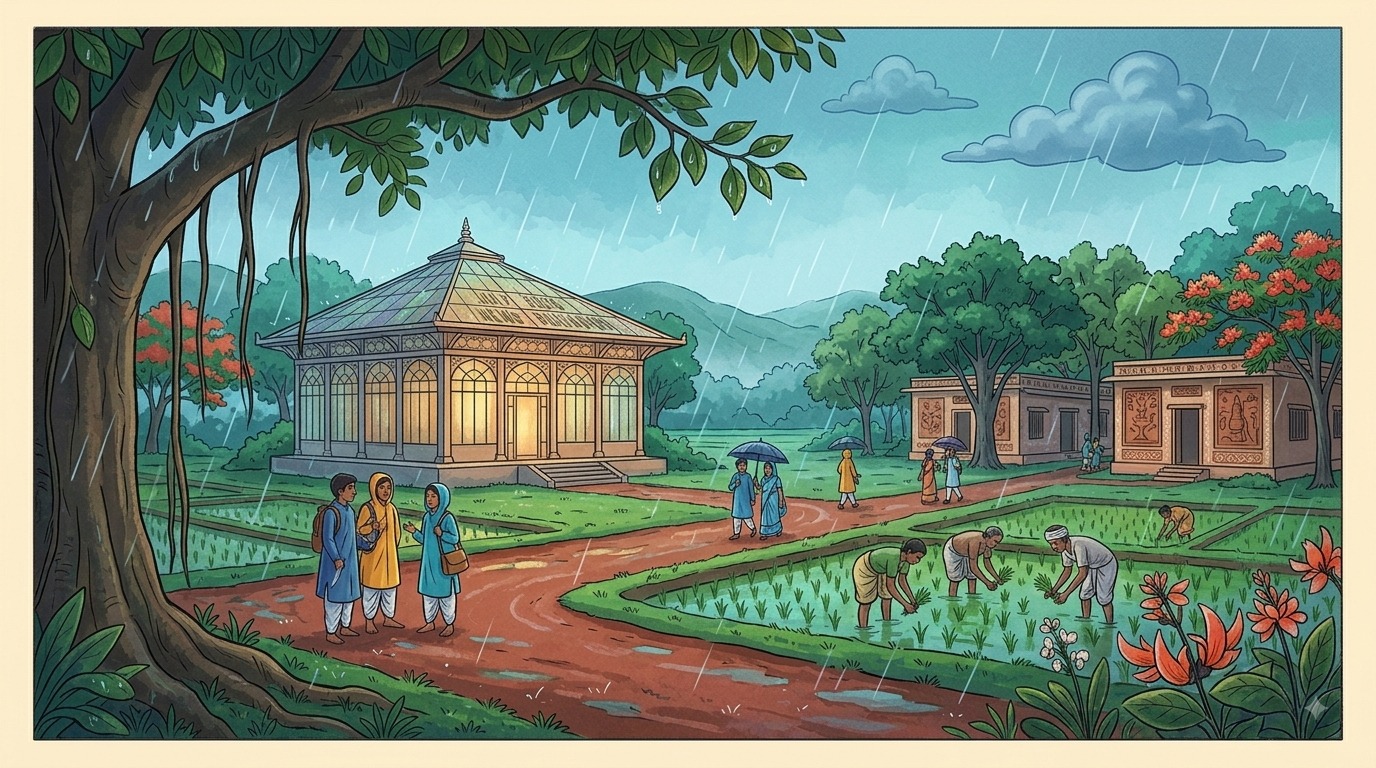
If June was the month Santiniketan changed its name from summer to monsoon, July is the month it changes its population. The rains that arrived tentatively in mid-June have, by July, settled into their true rhythm — heavy, frequent, sometimes relentless — and against this backdrop of grey skies and running water, the town’s most human drama unfolds: the annual arrival of a new generation, trunks in hand, umbrellas turned inside out by the wind, stepping off trains at Bolpur station into a place they have only imagined until now.
There is something quietly moving about watching Visva-Bharati fill up again in July. The empty hostel corridors of June acquire footsteps. The library, which had settled into its administrative hush, begins to hear the particular murmur of students meeting each other for the first time. And the rain, far from being an inconvenience to this process, seems almost complicit in it — as if the campus wanted its newest arrivals to understand, from their very first days, that Santiniketan‘s beauty and its unpredictability are the same thing.
July is also a month of ritual. Rath Yatra’s chariots roll through Bengal’s towns. Guru Purnima, a few weeks later, turns attention toward teachers and the debts a student never quite repays. In a town built on Tagore’s belief that education is inseparable from reverence, this month’s calendar could hardly be more fitting.
JUNE INTO JULY: THE RAINS DEEPEN, THE CAMPUS STIRS
June had established the monsoon’s presence. July confirmed its authority, bringing Birbhum into its wettest and most physically demanding stretch of the year — even as the university’s administrative machinery moved from quiet planning into visible, public-facing action.
- The pattern of afternoon cloudbuilding and evening downpour that had characterised June’s second half continued and intensified through July, with Bolpur and its surrounding villages experiencing some of the season’s heaviest rainfall — the kind that turns unpaved lanes to mud and tests every roof and drainage channel the town possesses.
- Against this weather, the administrative calendar refused to slow down. Visva-Bharati’s various admission cells, examination sections, and departmental offices ran at their busiest pace of the year, processing the paperwork that would determine, for thousands of families, whether the coming academic year would begin in Santiniketan or elsewhere.
- The overlap between monsoon intensity and admissions urgency produced a particular July scene repeated across the town: parents and prospective students dashing between hostel offices and admission counters under shared umbrellas, the rain an unwelcome but ultimately minor obstacle in the face of decisions that would shape years.
1. CUET COUNSELLING OPENS — THE UNDERGRADUATE GATE
The most consequential administrative event of Visva-Bharati’s July was the opening of counselling registration for undergraduate admissions through the Common University Entrance Test — the primary gateway through which most new undergraduates now enter the university.
- CUET UG counselling registration for the 2026–27 academic year opened on the Samarth Portal at one minute past midnight on 16 July 2026, with candidates required to register using their CUET application number and date of birth before receiving an email verification code to activate their accounts.
- The last date to apply was set at 29 July, 11:55 PM, giving candidates a two-week window that admissions counsellors across Bengal universally describe as both generous and, for anxious families juggling multiple university applications simultaneously, never quite long enough.
- A correction window opened on 31 July and closed on 1 August, allowing candidates to fix errors in their submitted forms — profile details excepted — before the university proceeded to its next and most anxiously awaited step: the declaration of the merit list, expected in the last week of August.
- For families across West Bengal and beyond, the CUET counselling window represents the practical culmination of months of preparation, and July’s rain-soaked cybercafés and college computer labs, filled with students carefully uploading documents before the deadline, are as much a part of Santiniketan’s July character now as any festival.
2. THE RURAL MANAGEMENT ADMISSION TEST AND OTHER DEPARTMENTAL NOTICES
Beyond the university-wide CUET process, individual departments continued their own admission and academic notices through July, reflecting the layered, decentralised nature of how Visva-Bharati actually runs.
- The Department of Lifelong Learning and Extension held its admission test for the M.A. in Rural Management programme on 15 July 2026, drawing candidates interested in one of the university’s more distinctive offerings — a programme whose subject matter, fittingly, has particular resonance in a region where rural development and craft-based livelihoods are so central to daily life.
- Other departments issued their own scattered notices through the month — extensions to research proposal submission deadlines, ticketing arrangements for Bhasha-Bhavana library events, and the usual accumulation of academic housekeeping that rarely makes headlines but keeps a university of Visva-Bharati’s complexity actually functioning.
- For prospective students navigating this landscape of overlapping deadlines and department-specific processes, July is often the most bureaucratically demanding month of the year — a fact that campus veterans and admission helpline staff (fielding calls from 10:30 AM to 5:30 PM on all days except weekends and holidays) understand better than anyone.
3. RATH YATRA — CHARIOTS ROLL ACROSS BENGAL
Rath Yatra, one of the subcontinent’s great chariot festivals, arrived on 16 July 2026, and while its most famous celebration unfolds hundreds of kilometres away in Puri, Bengal marks the day with its own vigorous traditions of devotion and community celebration.
- Schools across West Bengal, Odisha, and Manipur observed a holiday for Rath Yatra on 16 July, and Santiniketan’s own educational institutions — Patha Bhavana included — paused their regular schedule to mark the occasion, giving students and families a rare mid-monsoon break.
- Local chariot processions, organised at a community rather than institutional scale, moved through parts of Bolpur and surrounding villages, with devotees pulling smaller raths through rain-slicked streets in a scene that combined solemn devotion with the practical improvisation that monsoon-season festivals in Bengal always require.
- In Puri itself, the grand procession continued its traditional multi-day arc — Sandhya Darshana on 22 July, Bahuda Yatra on 24 July, Suna Besha on 25 July, and Niladri Bije closing the festival cycle on 27 July — a sequence that Bengali devotees, including many in Birbhum, followed with keen attention even from a distance.
4. GURU PURNIMA — HONOURING THE TEACHER IN A TOWN BUILT ON TEACHING
Few festivals resonate with Santiniketan’s founding philosophy quite as directly as Guru Purnima, observed this year on Wednesday, 29 July 2026, the full moon day of the Hindu month of Ashadha.
- With the Purnima tithi beginning at 6:18 PM on 28 July and extending through 8:05 PM on 29 July, panchang-following communities across India confirmed the 29th as the correct observance date — a small but earnestly debated point of astrological detail that recurs, with mild good humour, in Bengali households every year.
- Though not a nationwide public holiday, Guru Purnima carries particular weight in an institution founded explicitly on Tagore’s belief in the guru-shishya relationship as the heart of true education. Several bhavanas marked the day informally — students offering respects to senior faculty, small gatherings acknowledging mentors past and present, the kind of quiet observance that a university built on personal relationships between teacher and student tends to produce without needing official sanction.
- For a town whose very foundation rests on the idea that learning is a form of devotion, Guru Purnima in July felt less like an imported religious festival and more like a formal articulation of something Santiniketan practises, in smaller ways, every single day of its academic calendar.
5. THE LANDSCAPE AT ITS WETTEST — KHOAI, SONAJHURI, AND THE RIVERS
July pushed the monsoon transformation that began in June to its fullest expression, with Santiniketan’s signature landscapes reaching what many longtime residents consider their most dramatic seasonal state.
- The Khoai ravines, already transformed by June’s early rains, deepened further into a landscape of running water, thick grass, and swollen gullies — beautiful but genuinely treacherous underfoot, and local guides began cautioning visitors against unaccompanied walks in the wettest stretches.
- Ajay and Kopai rivers, which frame the region’s geography, ran fuller and faster through July than at any other point in the year, their swollen banks a reminder of how directly this landscape’s agricultural rhythm and Tagore’s own poetic imagination were shaped by monsoon water.
- Farmers in villages surrounding Santiniketan continued paddy transplantation through July’s rains, the fields turning that particular saturated green that has, for over a century, provided the backdrop against which the ashram’s cultural life has unfolded — a reminder that Santiniketan’s beauty was never separate from its agricultural context, only ever layered on top of it.
6. ARTISANS AND COMMUNITY IN THE HEAVIEST RAINS
July’s intensified monsoon continued to shape the practical rhythms of craft production and daily community life established in June, with adaptations now settling into their seasonal routine.
- Terracotta and pottery artisans continued managing reduced production through covered drying and indoor firing arrangements, using the slower months to focus on design work, tool maintenance, and the kind of patient planning that the frantic pre-Poush-Mela months never allow.
- Kantha embroidery collectives, insulated from the weather by the indoor nature of their craft, continued steady work on ambitious pieces for the coming festival season, with the digital sales channel that has been quietly growing since March providing a modest but appreciated source of monsoon-season income.
- Community drainage and infrastructure concerns, flagged in June, continued into July as heavier rains tested municipal systems further — an annual test that Bolpur’s local bodies approach with a mixture of practised competence and the perennial acknowledgment that some improvements are easier to discuss than to fund.
LOOKING AHEAD: AUGUST AND THE CAMPUS FILLS
As July closes, Santiniketan looks toward an August that will bring the CUET merit list, the arrival of confirmed new students, and the full resumption of academic life.
- The CUET UG merit list, expected in the last week of August, will trigger the final wave of admissions activity — hostel allocations, orientation programmes, and the particular chaos and joy of a new undergraduate cohort discovering the campus that will shape their next several years.
- Independence Day on 15 August will bring its own institutional observances across Visva-Bharati and Patha Bhavana, a patriotic counterpoint to the personal, philosophical reverence of Guru Purnima just weeks earlier.
- And the monsoon, though beginning its very gradual retreat toward September, will still have plenty left to give — meaning August’s Santiniketan will likely combine the settling-in of new students with the continued, deep green drama of a landscape not yet ready to let go of its rains.
July brought the rain to its fullest voice and opened the university’s gates to its newest arrivals — two forms of renewal, oddly matched, quietly reinforcing each other.