
EDITORIAL: THE RAINS ARRIVE, AND THE TOWN CHANGES ITS NAME
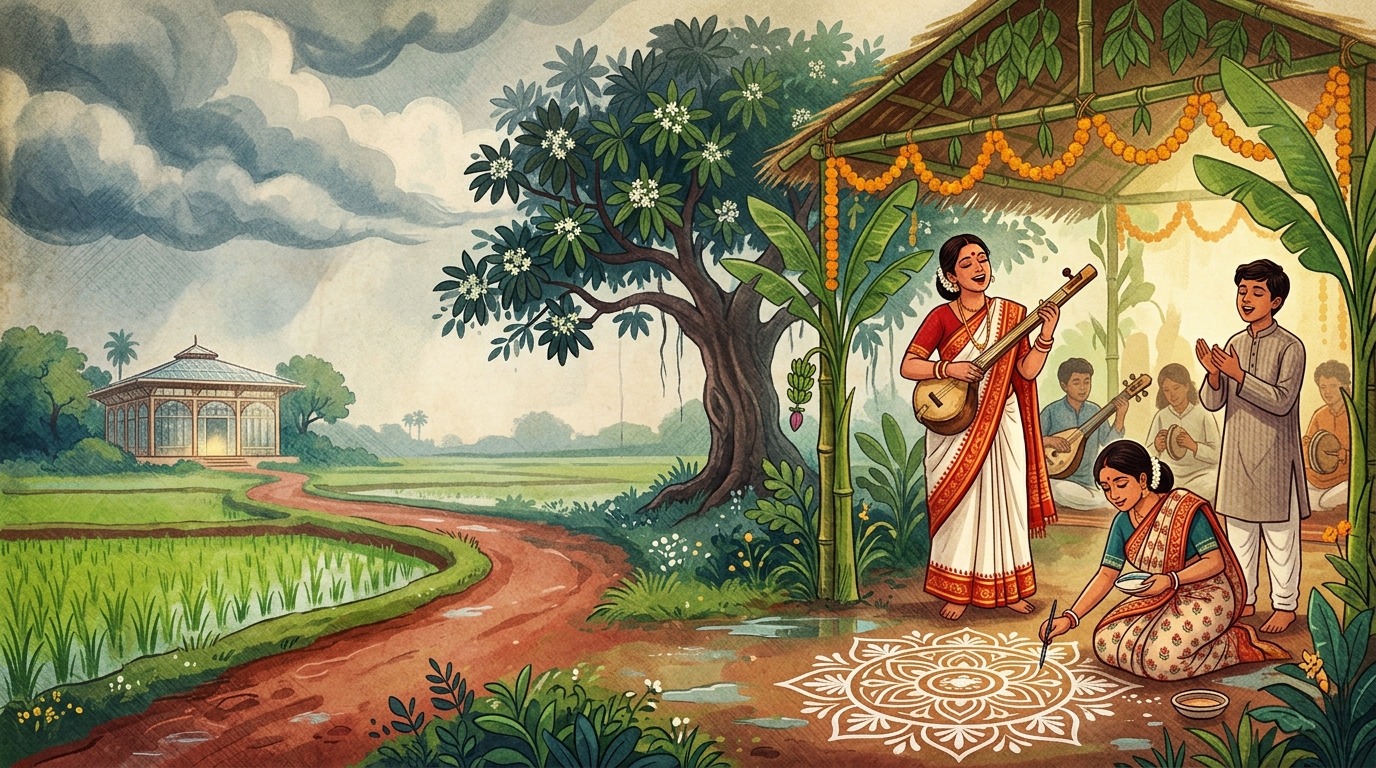
There is a moment every June — never announced in advance, never quite the same date twice — when Santiniketan stops being the parched, pale-red landscape of April and May and becomes, almost overnight, something else entirely. The first real monsoon rain does not fall gently. It arrives as an event: a darkening sky over the Khoai, a wind that smells of wet earth before a single drop lands, and then the deluge — loud on tin roofs, urgent on the sal leaves, transformative on the laterite paths that drink it in and turn, within hours, the deep rust-red that gives this soil its character.
By the time the rain eases, the town has changed its name in every sense but the official one. It is no longer summer’s Santiniketan, dusty and withdrawn. It is monsoon Santiniketan — green in a way that seems to arrive from nowhere, alive with frogs and birds that had gone silent through May, and quietly, unmistakably beautiful in the manner that only people who have chosen to be here in the rains ever get to witness.
This is also the month when the institutional year turns over. Results are behind us. Admissions notices multiply. New students, in ones and twos, begin to appear at the station with trunks and uncertain expressions, precisely as the sky performs its most dramatic seasonal transformation right on cue to welcome them.
MAY INTO JUNE: THE MONSOON’S ADVANCE
May had ended with the first faint signals — a heaviness in the air, distant thunder, a shift in the quality of afternoon light. June made good on all of it, decisively and on national schedule.
The India Meteorological Department confirmed the Southwest Monsoon’s steady advance through the second week of June, with the rain front moving into West Bengal, Bihar, Jharkhand, Odisha and neighbouring states in a sequence of daily bulletins that Birbhum district residents, as always, tracked with the keen attention of people whose entire agricultural and domestic calendar depends on it.
By mid-June, heavy to very heavy rainfall — in the range of 12 to 20 centimetres — had been recorded at isolated places across Gangetic and Sub-Himalayan West Bengal, with the IMD issuing specific warnings for the region through the third and fourth weeks of the month, including a notable spell of isolated extremely heavy rainfall flagged for 27–29 June.
For Santiniketan and Bolpur, this translated into the familiar June pattern: bright, humid mornings giving way to towering afternoon clouds, and then — some days gently, some days with real force — the rain itself, followed by evenings of extraordinary clarity, the air washed clean, the temperature finally, mercifully broken.
1. THE LANDSCAPE TRANSFORMED — KHOAI AND SONAJHURI IN GREEN
Nothing in Santiniketan’s annual cycle rivals the visual transformation of June. Visitors who know the Khoai only from its dry-season photographs — pale, sculpted, almost lunar — would scarcely recognise it after two or three weeks of monsoon rain.
The Khoai ravines, cracked and dust-pale through April and May, filled with pooled rainwater and fresh grass within days of the first heavy showers, the red laterite now streaked and softened by running water. Photographers who make the effort to visit in this window describe light and colour combinations that the dry months simply cannot produce.
Sonajhuri forest turned an almost impossible green, the sal trees in full leaf, the undergrowth thick and vigorous, and — for those willing to risk a slightly muddy walk — an entirely different sensory experience from the dusty haat-day crowds of the festival season. The forest in monsoon belongs to birdsong, not tourism.
Local naturalists and longtime residents describe June and July as the season of the frogs and the fireflies — a nightly chorus and shimmer that the town’s quieter lanes offer to anyone patient enough to sit outside after dark. It is, by most accounts, one of Santiniketan’s least advertised and most genuinely magical experiences.
2. VISVA-BHARATI’S ADMISSIONS SEASON BEGINS IN EARNEST
While the rains transformed the landscape, the university’s administrative machinery moved into its busiest cycle of the year: preparing for a new academic session amid a flurry of application deadlines, document verifications, and notice-board announcements.
The application window for international students seeking admission to Class XI, undergraduate, and postgraduate programmes for the 2026–27 session — which had opened on 21 May — closed with a final extended deadline of 16 June 2026, after an initial extension from 8 June. The process, conducted through a dedicated Google Form application route, reflected Visva-Bharati’s continuing effort to formalise and streamline its international intake.
Postgraduate admission notices continued rolling out through the month and into early July, with departments including Economics, History, Physics, Zoology, and Chinese Studies publishing category-wise seat allocations and merit positions — the dry, procedural language of admission notices carrying, for the students and families reading them anxiously, some of the highest emotional stakes of the year.
The broader 2026–27 academic session was expected to commence, per the university’s own indications, in the third week of July, meaning June’s admissions activity was effectively the quiet, paperwork-heavy prelude to the more visible arrival of new students that the coming month will bring.
3. CAMPUS IN TRANSITION — RESULTS, DEPARTURES, ARRIVALS
June found Visva-Bharati’s campus in a peculiar and rather moving state of overlap — the last graduating students still settling final matters even as the earliest signs of the incoming batch began to appear in admissions correspondence and hostel allocation queries.
Departments continued publishing even-semester examination results and revaluation notices through June, closing out the administrative tail of an academic year that had, in truth, concluded weeks earlier in spirit if not in paperwork. For some students, June brought the final, delayed closure of results they had waited on since April.
The campus’s physical rhythm in June is unlike any other month: fewer students in residence, but a steady trickle of parents and prospective students visiting hostels, meeting faculty, and trying to imagine what a life in Santiniketan might feel like — usually arriving, fittingly, in the middle of a downpour that either charms them completely or sends them straight back to their taxi.
Faculty describe June as a planning month in the truest sense: syllabi revised, teaching schedules finalised, hostel rooms reassigned, and the quiet administrative labour that makes the following month’s arrival of new students appear, from the outside, effortless.
4. ARTISANS IN THE RAINS — A DIFFERENT KIND OF PRODUCTION CALENDAR
Monsoon changes the practical realities of craft production across Birbhum’s artisan villages, and June’s arrival of serious rain required its own set of adaptations from Kantha embroiderers, Dokra metalworkers, and terracotta potters alike.
Terracotta and pottery workshops faced the most direct seasonal challenge: firing and drying processes that depend on sun and dry air become considerably harder to manage once the rains set in, forcing many potters to shift toward covered drying racks, indoor kilns, and a generally slower production pace through June, July, and August.
Kantha embroidery, being an indoor craft largely unaffected by weather, continued at its steady pace, with several collectives using the quieter monsoon months — free of both festival deadlines and the distraction of tourist traffic — to work on more ambitious, time-intensive pieces intended for the Poush Mela season still six months away.
The digital sales channel that had been slowly building since Nabanna Fair in March continued its gradual growth through June, with several artisan groups reporting that monsoon-season online orders, though modest, provided welcome income during what has traditionally been the leanest cash-flow period of the annual craft cycle.
5. COMMUNITY LIFE IN THE WET SEASON
The rains reorganise daily life across Bolpur and Santiniketan with their own quiet authority, and June’s community rhythms reflected the practical adjustments that monsoon always demands.
Drainage and road conditions became an immediate community concern as the first heavy spells tested infrastructure that had sat dry and cracked through the summer. Several localities saw waterlogging in low-lying lanes, prompting the kind of civic conversation about municipal drainage maintenance that recurs, with familiar urgency, every June.
Local markets adjusted their rhythms to the rain’s unpredictability: vendors covering stalls more carefully, shoppers timing their errands around the gaps between showers, and the general acceptance that a June day in Bolpur is planned loosely, with the sky as the final decision-maker.
For all its inconveniences, June’s rain brought genuine relief after the punishing heat of April and May — a mood of collective exhale visible in everything from children playing in the first downpour to farmers in the surrounding villages beginning their paddy transplantation, the agricultural calendar and the town’s own rhythms moving, as they always have, in tandem.
LOOKING AHEAD: NEW STUDENTS AND RATH YATRA
As June closes, Santiniketan looks toward a July that will bring both a fresh institutional beginning and one of Bengal’s most significant religious festivals.
The 2026–27 academic session is expected to formally commence in the third week of July, bringing a new cohort of students to the ashram’s classrooms, hostels, and studios — the cycle that closed with May’s tearful farewells beginning its next full turn.
Rath Yatra, one of the subcontinent’s great chariot festivals, falls on 16 July 2026, with the Snana Purnima ceremonies on 29 June marking its ceremonial beginning. While Puri remains the festival’s most famous stage, Bengal’s own Rath Yatra traditions — including smaller, community-organised chariot processions in towns across the state — bring their own colour and devotion to the region through the second half of July.
And through it all, the rains will deepen further, with July traditionally bringing Birbhum’s heaviest and most sustained monsoon spells — the Khoai fuller, Sonajhuri greener still, and Santiniketan settling into the season that its long-term residents quietly consider the most beautiful of the entire year.
June asked the sky to keep a promise, and the sky obliged. What follows is simply the town learning, again, how to be green.