
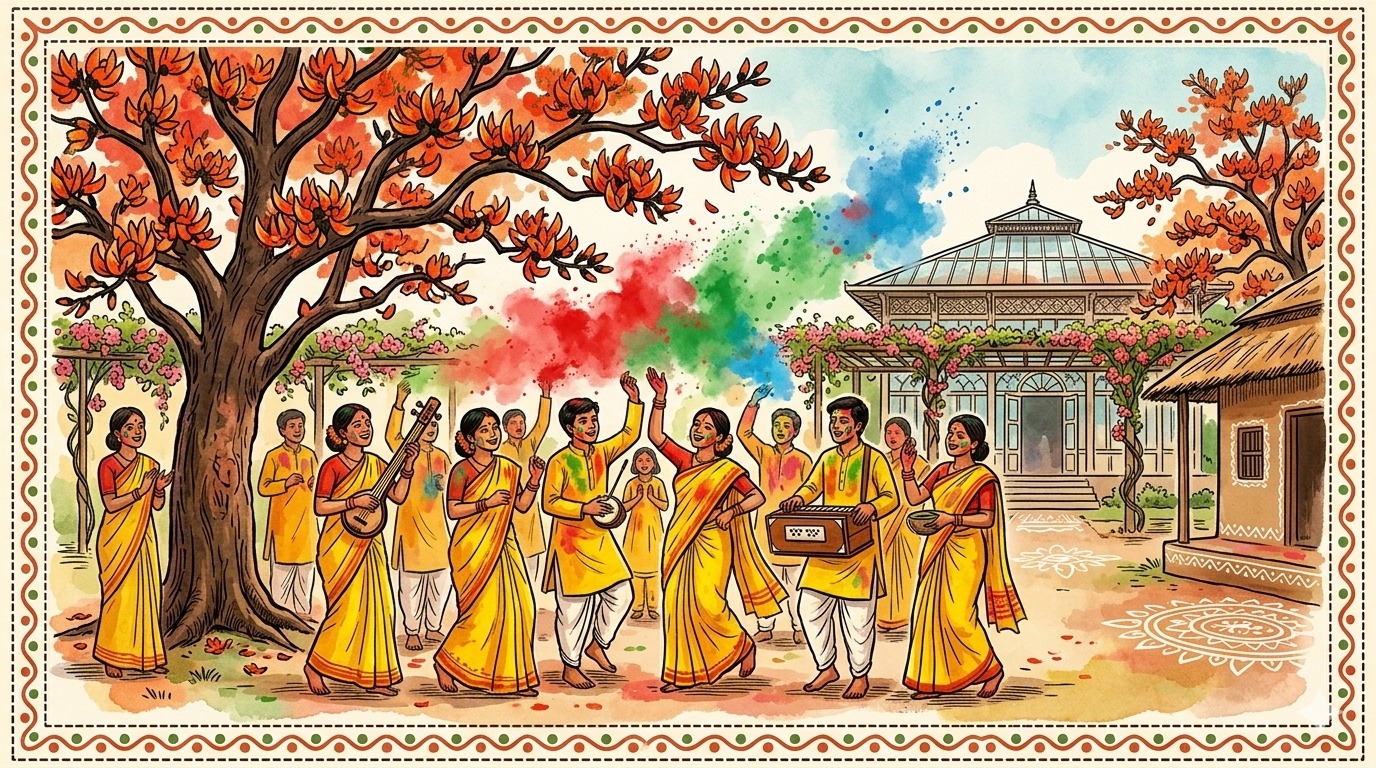
EDITORIAL: WHEN SPRING OVERFLOWS
There is a particular kind of silence that falls on Santiniketan in the days after Basanta Utsav. The red laterite paths, still faintly stained with abir, carry the memory of colour the way old cloth carries perfume — softly, without announcement. The palash petals that rained on singing students have already returned to the earth. The trains back to Kolkata have long since departed, full and loud and happy.
March in Santiniketan is two things at once: the loudest week of the year and the most contemplative aftermath. It is the town at the absolute height of its powers — colour, music, craft, crowd — and then, almost immediately, a return to the long, amber-lit afternoons that are, perhaps, Santiniketan’s truest self.
This bulletin holds both. The eruption and the settling. The festival and the morning after.
JANUARY INTO MARCH: THE ARC OF THE SEASON
February handed March a town already warm, already stirring, already anticipating. The artisans had shifted from planning to production. The campus was alive with semester rhythm. The Nabanna Fair had already opened its gates at Geetanjali. March simply brought it all to the boil.
- The academic calendar, which had managed to coexist gracefully with February’s festival intensity, compressed slightly in March’s first fortnight as Basanta Utsav preparations and post-festival decompression sandwiched the regular teaching schedule. Faculty and students navigated this with the practised ease of long institutional habit.
- Bolpur town itself — the market streets, the station road, the toto stands outside the ashram gates — ran at a different pace in March’s first week, absorbing a volume of visitors that tested its infrastructure while demonstrating, as it does every year, a remarkable local resilience.
- The season’s emotional arc was clear: February had been anticipation, and March became fulfilment — and then, before the month was out, the first tentative exhale of a town beginning to return to itself.
1. BASANTA UTSAV 2026 — THE MORNING OF SONG AND COLOUR
Basanta Utsav arrived on March 3, 2026, and it arrived, as it always does, before most visitors had finished their morning tea. By the time the sun had cleared the ashram trees, the air inside Visva-Bharati was already thick with song, with colour, and with the kind of joyful disorder that only a festival rooted in Tagore’s philosophy of living learning can produce.
- The day began at dawn with Basanta Bandana — the invocation of spring through Rabindra Sangeet performed by students and faculty on the open grounds. Those who arrived early enough to hear the first notes in the half-light before abir was thrown will likely carry that memory for years.
- By mid-morning, students in basanti (deep yellow) and white moved through the campus in singing processions, faces flushed with colour, instruments carried loosely, the formality of performance dissolved entirely into participation. The distinction between performer and audience — always provisional at Visva-Bharati — ceased to exist.
- The afternoon wound down with deliberate quietness. This, too, is tradition: the festival’s intensity is compressed into the morning hours, and by early afternoon the campus begins to breathe again, allowing the ashram’s essential contemplative character to reassert itself before evening.
Basanta Utsav 2026 was, by most accounts, a morning of particular beauty — helped by clear skies, cooperative temperatures, and the continued creative energy that has marked the post-UNESCO-recognition phase of Santiniketan’s cultural life.
2. WHERE THE COLOURS MOVED: SONAJHURI, KHOAI & SHILPAGRAM
The growth of Basanta Utsav’s reputation — accelerated sharply by social media and the UNESCO World Heritage listing — means that the campus itself can no longer absorb all of the demand the festival generates. In 2026, this redistribution of festivity reached a new equilibrium that is, arguably, richer for its spread across the landscape.
- Sonajhuri forest became the primary venue for colour play among visitors who either could not access the campus or chose the forest’s wilder, more open atmosphere. Baul musicians performed under the sal trees through the morning and into the afternoon, giving the festival a folk-music dimension that the campus programme, rooted in Tagore’s classical aesthetics, does not always foreground.
- Khoai — the ravine-and-laterite landscape beloved of painters — was transformed on Basanta Utsav morning into something almost unearthly: figures in yellow moving across red earth, abir catching the light, the old silence of the terrain in conversation with the sound of singing. Photographers and artists arrived in numbers.
- Srijani Shilpagram and several nearby resorts offered curated Basanta experiences with live music, controlled colour play, and guided craft demonstrations — an option that suited families, older visitors, and those who wanted the spirit of the festival without the crowd intensity of the main ashram area.
This dispersal, sometimes described as a problem of overcrowding, might also be understood as a festival ecosystem maturing — finding multiple expressions of the same essential joy across different corners of the landscape.
3. TOURISTS, TRAINS AND A TOWN STRETCHED TO ITS LIMIT
Santiniketan absorbs its festival crowds with a kind of stoic generosity, but March 2026 tested that generosity at its edges. The combination of Basanta Utsav, Nabanna Fair, and the accumulated spring-season momentum brought visitor numbers that required, as every year, a negotiation between welcome and sustainability.
- Trains from Howrah and Kolkata to Bolpur were fully booked in both directions across the Basanta Utsav weekend, with several additional special services running to manage demand. Day-trippers arriving without advance planning found the station taxi stand and toto queue stretched to unusual lengths.
- Accommodation across Bolpur and Santiniketan — homestays, guesthouses, heritage bungalows, and resort properties — reported near-full occupancy for the first week of March. Several hosts noted that guests who could not find rooms in Santiniketan proper had booked properties as far as Suri and Rampurhat, treating the region as a wider destination.
- Experienced visitors and locals alike shared a quiet consensus: early morning and after 4 PM remained the best windows to experience Santiniketan’s natural atmosphere during peak season — the hours before crowds thicken, and the long, golden evenings when the day-trippers have departed and the town returns, briefly, to its own tempo.
4. NABANNA FAIR 2026 — TEN DAYS OF FOLK ART AT GEETANJALI
While Basanta Utsav compressed its intensity into a single luminous morning, the Nabanna Folk Art and Craft Fair spread its gifts across ten generous days — February 27 to March 9 — at the Geetanjali Cultural Complex, Bolpur, open daily from noon to 8 PM.
- The fair, organised by the Suresh-Amiya Memorial Trust under its Praner Utsab (“Festival of the Soul”) banner, brought together artisans working in Kantha embroidery, Dokra metal craft, terracotta, Batik, Patachitra scroll painting, and handloom weaving — a concentrated survey of Bengal’s living craft traditions under a single canopy.
- Beyond commerce, the fair functioned as a living demonstration space: artisans worked at their craft in front of visitors, explaining process, material, and tradition in the informal, generous manner that is particular to the Birbhum craft community. Watching a Dokra piece emerge from a wax mould, or a Kantha pattern grow stitch by stitch, is an education in patience that no museum can replicate.
- Evening programmes deepened the experience: folk music performances, Baul sessions, art competitions for children, and a food court offering traditional Bengali dishes gave the fair a cultural completeness that extended well beyond the craft stalls. The health camp within the fair grounds offered a small but meaningful gesture of community service alongside the celebration.
The Nabanna Fair’s closing weekend coincided with the quietening of the Basanta Utsav rush, giving it a final burst of unhurried attendance — visitors who stayed on after the festival, or who arrived specifically for folk art rather than colour play, finding the stalls and the artisans in a mood of relaxed, generous engagement.
5. CAMPUS AND COMMUNITY: AFTER THE FESTIVAL HIGH
The morning after any great festival carries its own particular feeling — a mix of satisfaction, mild weariness, and the gentle urgency of ordinary life reasserting itself. Santiniketan on March 4 had that feeling, writ large across its paths and courtyards and tea stalls.
- Clean-up efforts along Sonajhuri, the Khoai pathways, and the campus periphery began early, organised partly by the university and partly by informal groups of residents and concerned visitors. The care taken to restore the landscape to its quiet integrity spoke to a community that takes seriously the responsibility of hosting the world.
- Conversations about sustainable cultural tourism — already circulating in Santiniketan’s resident and academic communities — grew more pointed in March’s aftermath. What is the right number of visitors for Basanta Utsav? How can the festival’s joy be preserved without eroding the conditions that make it joyful? These are not new questions, but each year they arrive with more urgency.
- On campus, the return to academic rhythm was swift and purposeful. Sangeet Bhavana resumed its regular teaching schedule. Kala Bhavana studios reopened with end-of-semester projects gathering momentum. The university’s evening talk series continued, shifting in theme from the spring festivals to the longer arc of Tagore’s creative legacy — a grounding, reflective pivot that felt entirely right for the post-festival mood.
6. ARTISANS: REVIEWING THE SEASON, PLANNING THE OFF-MONTHS
March’s closing days are, for Santiniketan’s artisan community, a moment of reckoning and recalibration. The festival season — from Poush Mela in December through to Nabanna’s closing in March — is over, and the quieter months ahead demand a different kind of planning.
- Kantha embroidery collectives reviewed their March sales with cautious satisfaction: the direct-buyer model at Nabanna had worked well, and several groups had completed their first trial listings on digital craft platforms, with early orders providing both income and confidence for the model’s long-term viability.
- Dokra and terracotta artisans noted that the UNESCO heritage recognition continued to draw serious, informed buyers willing to pay appropriate prices for authentic work — a slow but meaningful shift from the bargaining-heavy souvenir dynamic that had long frustrated skilled craftspeople trying to sustain livelihoods through their art.
- The off-season, while quieter in revenue, is when the deepest creative work happens: the experiments with new forms, the prototyping of pieces that will debut at the next Poush Mela, the patient skill-transfer from master artisans to younger apprentices that ensures these traditions continue to live rather than merely persist.
LOOKING AHEAD: SUMMER’S QUIETER RHYTHMS
As March turns to April, Santiniketan changes register entirely. The festival crowds disperse. The air grows warmer, then hot. The trees that blazed with palash and abir settle into deep summer green. The town, as it always does, finds its quieter self.
- The academic calendar moves into its final stretch — exams, assessments, end-of-year performances, and the bittersweet farewells of graduating students who have spent years learning under these trees and must now carry what they have learned out into the wider world.
- Cultural life does not pause; it moves indoors and into the evening. Baithaki concerts — intimate, unannounced, the musical equivalent of a private conversation — become the preferred form. Readings, poetry evenings, small exhibitions in studio spaces: Santiniketan’s cultural life in summer is less spectacular and infinitely more personal.
- For visitors willing to come in April and May — to accept the heat in exchange for the silence — Santiniketan offers something the festival season rarely allows: the town without its performance face. The paths unhurried, the haat unhurried, the conversations unhurried. A version of Santiniketan that only the patient and the curious are privileged to know.
Spring has been. Summer is arriving. And Santiniketan, as always, will be exactly what the season asks of it.