
EDITORIAL: THE SEASON AWAKENS
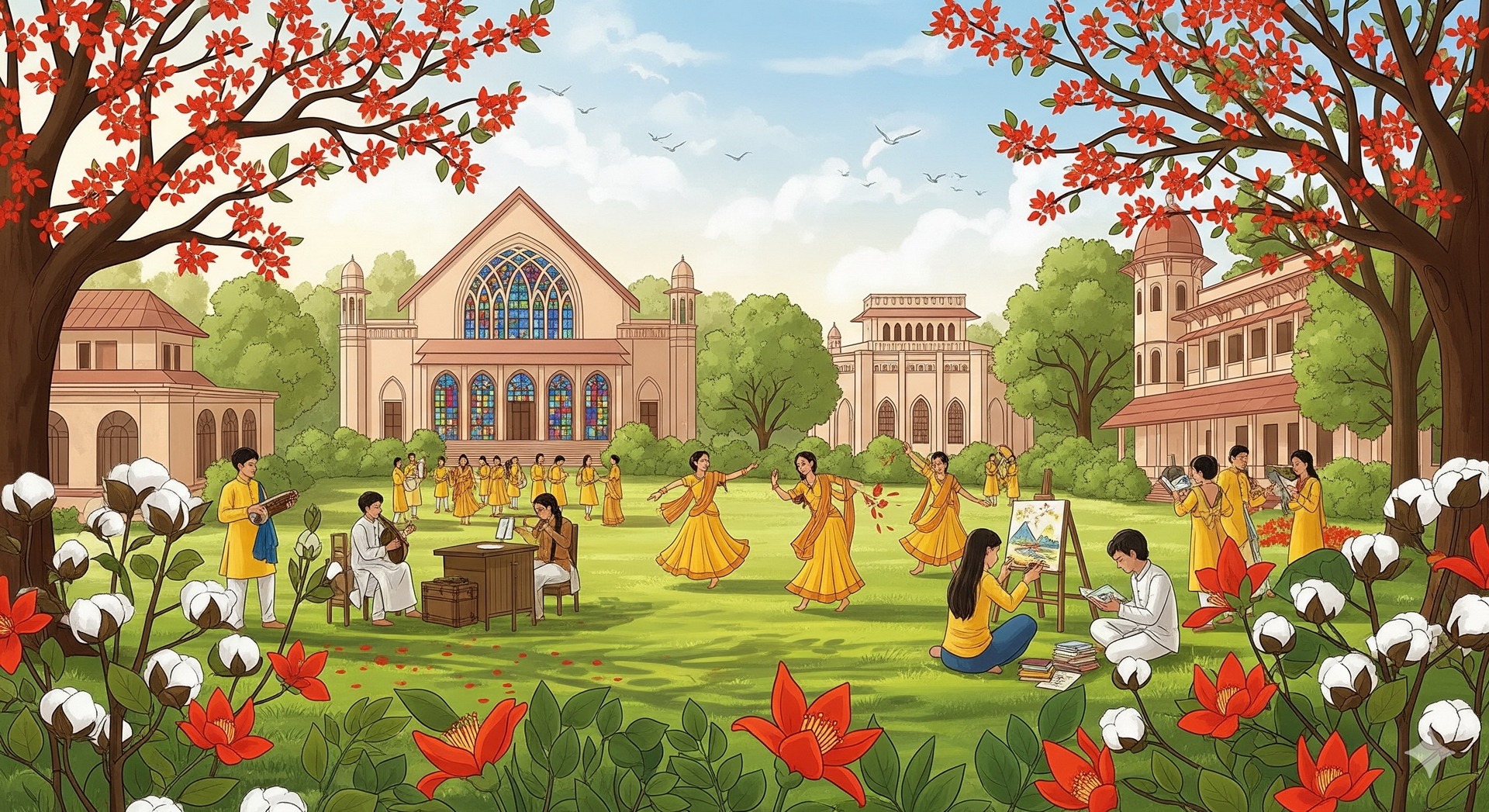
The palash trees do not ask permission before they bloom. One morning in February, you look up and the branches that were bare and grey have erupted in a fierce, wordless orange — and you know, without being told, that winter is finally over in Santiniketan.
February is the month when this town does not merely anticipate spring; it becomes it. The preparations whispered through January — the rehearsals inside Kala Bhavana, the quiet artisan workshops, the committee meetings in ashram corridors — all converge in February’s first weeks into something luminous and unmistakable: Maghotsav, Saraswati Puja, the scent of abir already on the air.
This is Santiniketan at its most itself.
JANUARY INTO FEBRUARY: THE TRANSITION COMPLETES
The disciplined stillness of January gave way by late month to something charged and expectant. The town did not flip a switch — the transition was gradual, almost musical, like a raga moving from its slow alaap into the faster gat.
- The first waves of spring visitors began arriving in the final days of January, filling homestays and guesthouses that had settled into a quieter post-mela rhythm. Hosts who had spent weeks on renovation and restocking found themselves welcoming guests again into noticeably refreshed spaces.
- Local transport networks — e-rickshaws, cycle rickshaws, the Bolpur station taxi stands — shifted back into their busier festival configurations, with drivers and guides dusting off their spring itineraries and knowledge of performance schedules.
- Weather cooperated generously: February mornings in Birbhum arrived warmer than expected, with clear skies and a breeze carrying the early fragrance of spring blossoms — ideal conditions for the outdoor performances and haat walks that define the season.
1. MAGHOTSAV 2026 — THREE DAYS OF SPRING FIRE
Maghotsav, Visva-Bharati’s beloved three-day cultural celebration of the arriving season, unfolded in late January and spilled into early February with characteristic intensity. Rooted in Tagore’s vision of an education that breathes the outdoors, the festival turned the ashram campus into a living stage.
- Kala Bhavana’s annual exhibition opened to considerable crowds, with graduating students and senior faculty displaying work that ranged from classical Tagore-inspired landscapes to bold, UNESCO-heritage-themed installations — a reflection of Santiniketan’s newly elevated global identity.
- Rabindra Sarovar amphitheater performances across the three days featured classical and semi-classical vocal music, Rabindra Nritya, and experimental dance-theatre pieces. Visiting artists from Kolkata, Dhaka, and Odisha added an inter-regional vibrancy to the lineup.
- The informal spaces between performances — shaded pathways, outdoor canteens, the grounds beneath the ancient trees — became gathering places as meaningful as the stage itself, where conversations between artists, students, faculty, and visitors wove their own quiet magic.
Maghotsav this year drew its largest educated, arts-focused audience yet, a sign that Santiniketan’s reputation as a destination for cultural depth — not just visual spectacle — continues to grow.
2. SARASWATI PUJA ON BASANT PANCHAMI — FEBRUARY 3
Basant Panchami — the fifth day of the bright fortnight of Magh — fell on February 3, 2026, and with it came Saraswati Puja, one of the most beloved rituals of the Visva-Bharati calendar.
- At dawn, the iconic Upasana Griha was ringed with marigold and palash garlands. Students from every bhavana — music, fine arts, humanities, science — gathered for the puja ritual, placing their books, instruments, and tools of craft at the goddess’s feet in the time-honoured tradition of seeking creative blessing.
- Through the morning, Sangeet Bhavana presented a programme of classical and Tagore songs in the open air, drawing a crowd that overflowed from the amphitheater onto the surrounding grass. Visitors who had not planned to attend found themselves sitting down and staying for hours.
- In the evening, Kala Bhavana opened its semester exhibitions to the public — a tradition that transforms the puja day into a full immersion in student artistic labour, inviting visitors to walk through studios and understand how Santiniketan’s educational philosophy looks in practice.
For many long-term residents, Saraswati Puja remains the most intimate of Santiniketan’s festivals — smaller than Poush Mela, more personal than Basanta Utsav, but deeply woven into the town’s sense of itself as a place where learning and devotion are inseparable.
3. CAMPUS LIFE: SPRING SEMESTER IN FULL RHYTHM
By mid-February, Visva-Bharati’s academic life had settled into its richest semester groove — the excitement of fresh admissions from January combined with the creative urgency of spring festival deadlines.
- Sangeet Bhavana expanded its public evening concert series in February, with students from intermediate and senior batches performing classical thumri, khayal, and Rabindra Sangeet in informal open-air sessions two evenings a week — free of charge, open to all.
- The Visva-Bharati Archives evening talks series, which launched in January, continued through February with a focus on Tagore’s creative process during the Bengali month of Falgun — a topic of particular resonance given the season. Attendance grew week on week.
- The ongoing negotiation between academic focus and festival energy — always a delicate balance at Visva-Bharati — was managed thoughtfully this February, with the university releasing a public cultural schedule that allowed both students and visitors to plan around each other’s rhythms.
4. SONAJHURI HAAT & KHOAI IN THE FEBRUARY LIGHT
February transforms Sonajhuri. The forest that appeared slightly bare and skeletal through January’s colder days now comes alive with new leaf, birdsong, and the particular golden light of the pre-spring afternoons. The weekly haat, always atmospheric, becomes something approaching magical.
- Weekend visitor demographics shifted in February toward a notably arts-and-culture-oriented crowd — couples on weekend escapes, solo artists and writers, and small groups of university students from Kolkata — all drawn specifically by the combination of the haat, the season, and the festival calendar.
- Baul music performances at Sonajhuri reached a high point in February, with several well-known practitioners arriving for informal sessions that stretched well past sunset. The tradition of sitting on the red earth listening to Baul singers under the trees felt, to many visitors, like the truest experience Santiniketan offers.
- The Khoai landscape — the ravine-and-laterite terrain that inspired so much of Tagore’s visual art — was at its most beautiful in February’s long afternoons, drawing photographers and walkers in notable numbers. Local guides reported high demand for evening Khoai walks timed to catch the last light.
5. NABANNA FAIR 2026 — FOLK ART ARRIVES AT GEETANJALI
February’s final weekend brought the opening of one of the region’s most anticipated folk art events: the Nabanna Fair 2026, organised by the Suresh-Amiya Memorial Trust at the Geetanjali Cultural Complex, Bolpur.
- The fair — running from February 27 through March 9, daily from 12 noon to 8 PM — describes itself as a Praner Utsab (“Festival of the Soul”), and the first days bore that name out: stalls by Kantha-stitch embroiderers, terracotta potters, Dokra artisans, and weavers from across Bengal filled the complex with colour and texture.
- A special “Nabanna Earth Weekend” within the fair focused on indigenous rice varieties and sustainable agriculture traditions, drawing both culinary enthusiasts and agricultural researchers curious about Bengal’s ancient grain heritage.
- Visitors could purchase directly from artisans — a model the fair has championed for years — ensuring that money flows to the makers themselves rather than through layers of intermediary commerce. For travellers tired of souvenir shops, it offered something rarer: genuine craft with a human face behind it.
The Nabanna Fair’s timing — bridging February and March, folk art and spring energy — makes it a perfect companion to the more institutionally anchored Visva-Bharati calendar.
6. ARTISANS: FROM PLANNING TO PRODUCTION
January’s careful artisan planning work translated, in February, into visible output. The workshops of Birbhum’s villages — many within cycling distance of Santiniketan — hummed with purposeful activity as craft producers moved from reflection into creation.
- Kantha embroidery groups from Bolpur and neighbouring villages reported strong early-season orders, with buyers from both Indian metros and international retailers following up on contacts made during Poush Mela. Several collectives experimented with smaller, travel-friendly formats to meet the needs of the growing “cultural souvenir” market.
- Dokra and terracotta artisans found that the UNESCO recognition continued to work in their favour: buyers increasingly cited the heritage designation as a reason to seek out authentic Santiniketan-area crafts over mass-produced alternatives, lifting demand and — slowly but meaningfully — prices.
- Discussions within craft promotion bodies about digital sales platforms gained momentum, with several collectives conducting trial listings on handloom and craft marketplaces. The response was cautious but encouraging — a tentative first step into a commerce model that could eventually reduce dependence on the mela season alone.
LOOKING AHEAD: MARCH & BASANTA UTSAV
As February closes, Santiniketan’s gaze turns — joyfully, inevitably — toward Basanta Utsav, the spring colour festival that draws the largest crowd in the town’s annual calendar.
- Basanta Utsav / Dolyatra is expected on or around March 4, 2026, coinciding with Holi. At Visva-Bharati, it takes its own distinct form: students dressed in yellow and white, dancing and singing Tagore songs as abir fills the air — a spectacle of colour rooted in something deeper than festivity.
- The Nabanna Fair continues through March 9 at Geetanjali Cultural Complex, offering visitors who come for Basanta Utsav a complementary folk-art programme that extends the cultural richness of the visit well beyond the single morning of colour.
- Homestay and hotel bookings for the first week of March are reportedly at capacity across much of Bolpur and Santiniketan. Visitors planning to attend Basanta Utsav are advised to confirm accommodation well in advance — and to consider quieter retreats slightly outside town for a more balanced experience.
Spring, in Santiniketan, is not merely a season. It is a state of creative being. March will remind us why.